How it works
A pipeline you can read, in accounts you own.
Starwisp is a set of GitHub Actions workflows, prompts and a small console. Claude Code does the building, in your repo, on your API key.
1. Install
npx starwisp initThe installer checks your license, downloads the release, creates two repos with your own gh, deploys the console with your own wrangler, and creates a GitHub App from a manifest through a one-time localhost callback. It writes the App's keys straight into your repo secrets, then opens the console's Setup page.
2. Connect
The Setup page is a checklist over your vault, with Test buttons and plain-language failures. Some vendors take days (D-U-N-S, Apple, Google Play, Twilio), so slow items show as "Waiting on vendor" and the rest continues.
3. Run
Pick a preset when you start a run:
Prototype
A live web preview on your own domain. No app stores. The backend stays on.
Ship to testers
The full path: web, TestFlight and Google Play internal testing.
Both get a per-run Claude dollar cap and a spend meter on the run page.
- IdeaYou write it down. A chat helps sharpen it.
- Vision & designScope, screens and a plan you can read.
- BackendSupabase schema, auth and policies in your project.
- BuildExpo app for iPhone, Android and web, as pull requests.
- Security gateHardening checks before anything ships.
- Verify & reviewTests, then an experience review of the running app.
- TestersYour TestFlight and Play internal builds, uploaded from your accounts.
- You & the storesApple and Google review. Nobody can skip it.
The console
You run it from a console deployed to your own Cloudflare account.
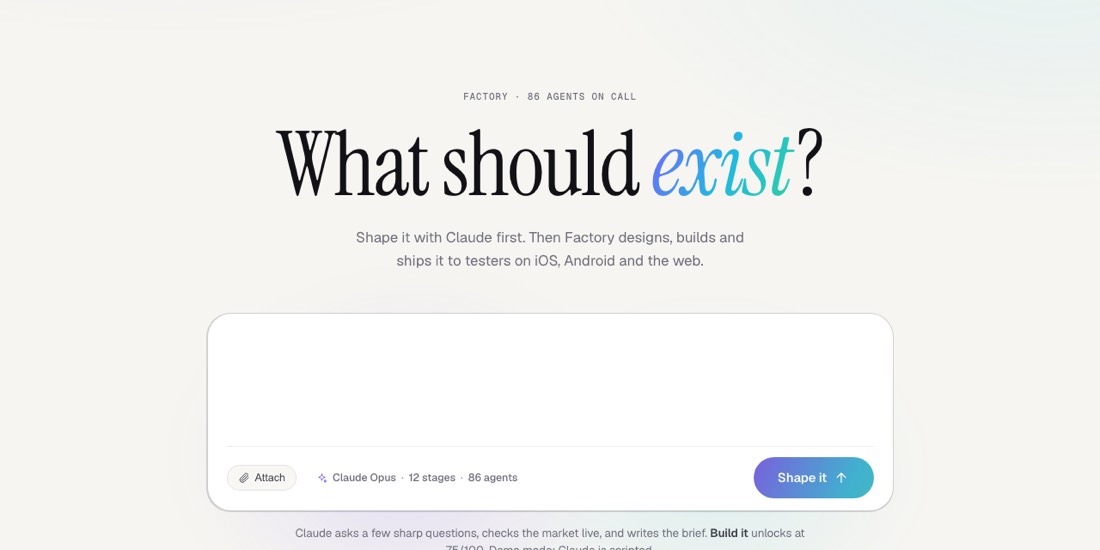
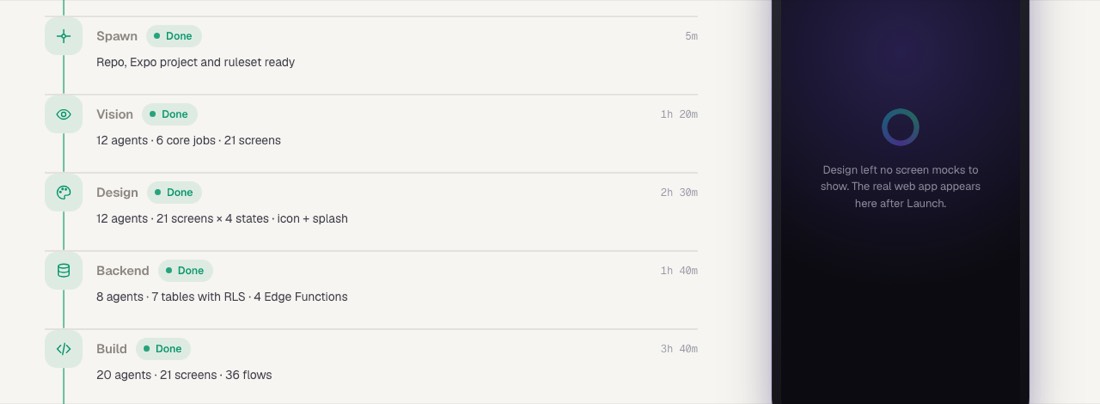
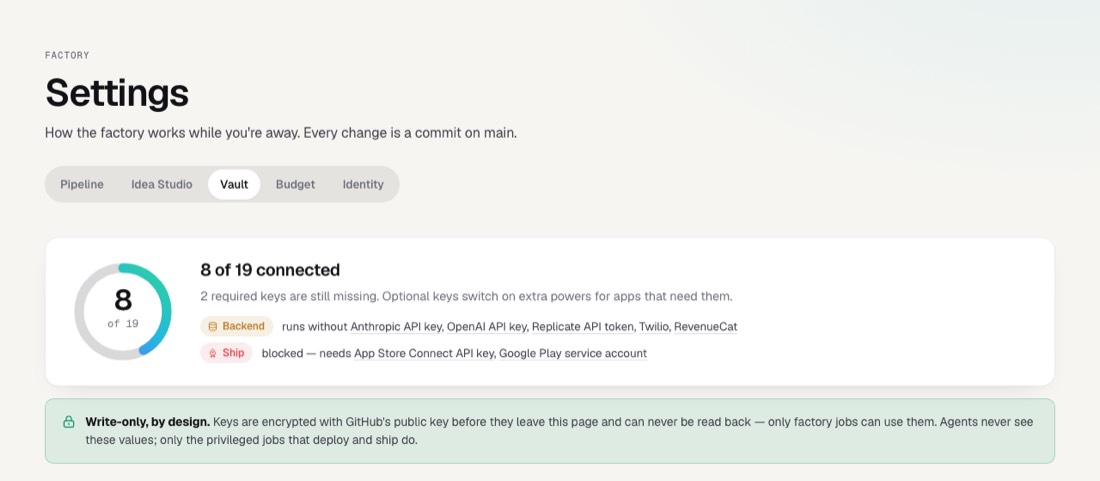
Console shown with demo data. Screens may change before release.
What is supported, and what is not
| Supported in v1.0 | Not supported in v1.0 |
|---|---|
| Expo / React Native apps with TypeScript | Flutter, native Swift/Kotlin, other frameworks |
| iOS, Android and a web build | Expo Go (the template uses a dev client and native modules) |
| Web preview deployed to Cloudflare | iOS ad-hoc builds on your iPhone without TestFlight |
| Android installable preview APK | Running without GitHub, or local-only mode |
| TestFlight and Play internal testing, uploaded from your accounts | Anyone publishing your app for you. We never submit anything. |
| Supabase backend, Resend email, optional Twilio SMS, push, AI features through the app's own proxy | Backends other than Supabase |
| English-language apps and store listings | Multi-language store listings |
| Your own accounts and keys at every vendor | Claude Pro/Max subscription tokens; any hosted tier |
The claim is "no human approvals until store review", not "fully automatic to the App Store". Apple and Google review cannot be skipped, and a new personal Google Play account needs 12 testers for 14 days first. Starwisp ends at TestFlight and Play internal testing; you take it from there.
Updates
A public release feed drives an "Update available" banner. The Update button runs a workflow in your repo that downloads the release with your license and opens a pull request. Releases published after your update window ends are refused, with a Renew link. Your own settings, budgets, memory and ledger are never touched by an update.